
Chapter 12: Trauma Bonding
Understanding Trauma Bonds
It is common for people in abusive relationships to leave and return to their partner multiple times before finally leaving for good (Lahav). Like many victims, I did attempt to move on. However, I was caught in a trauma bond, and I repeatedly returned to him, mistaking this bond for love.
Patrick Carnes defines trauma bonding in The Betrayal Bond: Breaking Free of Exploitive Relationships as “a psychological response to abuse. The target of the abuse typically develops sympathy for the abuser due to the cycles of affection and maltreatment they endure. As a result, the target forms a connection or attachment with their abuser and is reinforced to stay within the relationship” (Carnes, p. 30).
The intermittent reinforcement of affection followed by withdrawal or harm created a powerful attachment that made leaving feel not only painful, but impossible.
Figure 44 Dismissal and age-based shaming used to trivialize emotional harm and reinforce the trauma bond by framing pain as immaturity rather than abuse.
Symptoms of the Trauma Bond I Experienced
According to Carnes (p. 30), trauma bonds often manifest through the following patterns, many of which I experienced during this relationship:
· Obsessing about people who have hurt you long after they are gone
· Continuing to seek contact with people you know will cause further pain
· Going “overboard” to help people who have been destructive to you
· Repeatedly trying to get people who are clearly using you to like you
· Trusting people again and again despite their proven unreliability
· Being unable to distance yourself from unhealthy relationships
· Wanting to be understood by people who clearly do not care
· Staying in conflict when it would cost nothing to walk away
· Persisting in trying to convince people there is a problem when they refuse to listen
· Remaining loyal to people who have betrayed you
· Feeling drawn to untrustworthy individuals
· Maintaining contact with an abuser who accepts no responsibility for their behavior
At the time, I did not recognize these behaviors as symptoms of trauma bonding. I believed they reflected my capacity for love, loyalty, and forgiveness.
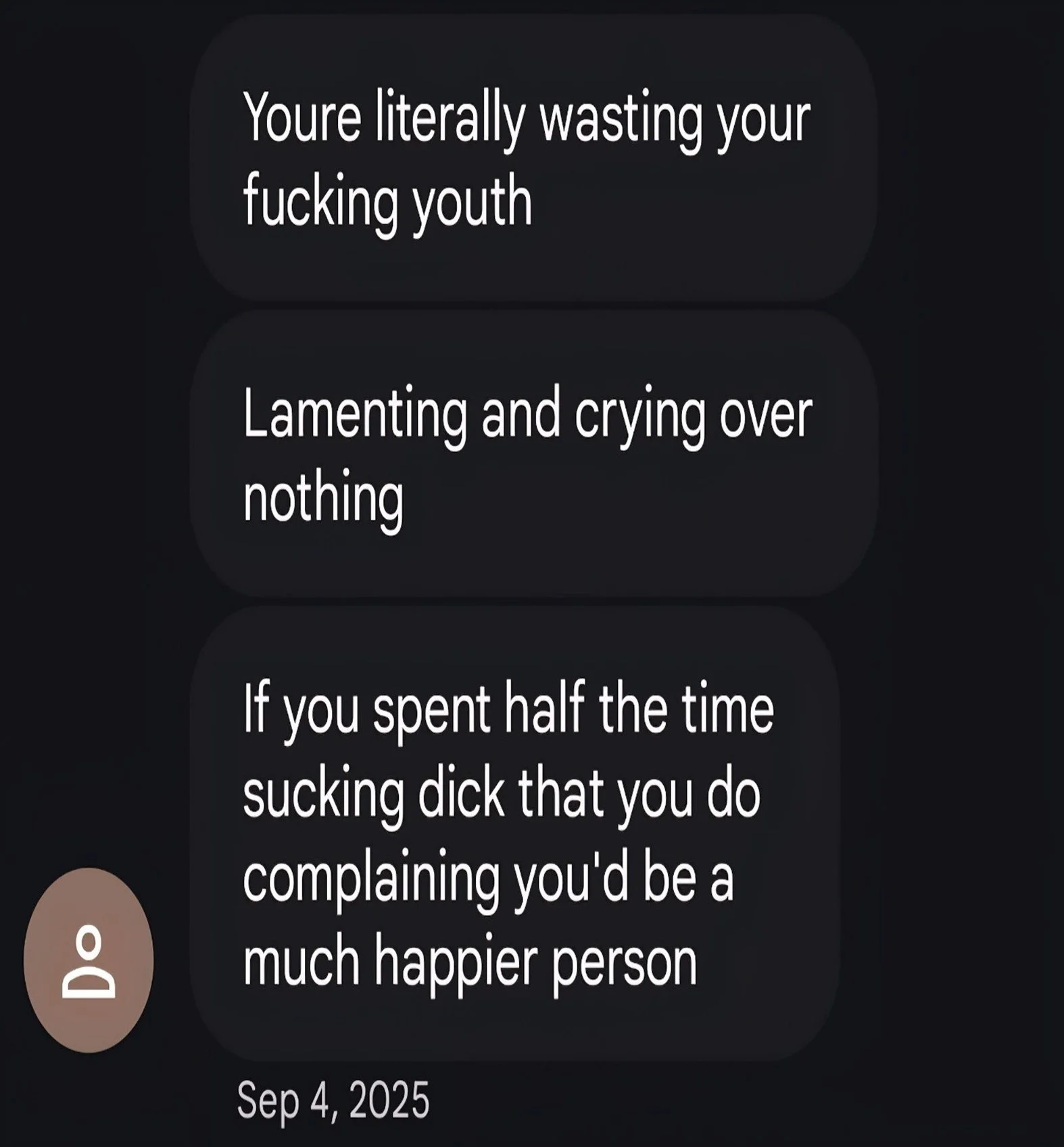
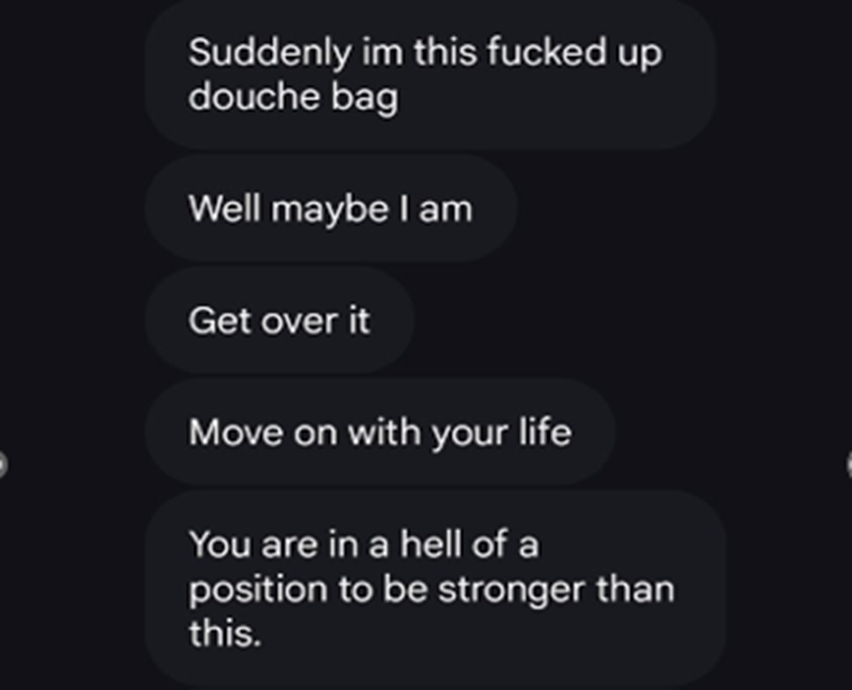
Figure 45 Verbal degradation and minimization used to invalidate distress and pressure emotional detachment (“move on” as a control tactic).
Trying to Break the Cycle
I did not know how to break the trauma bond or stop the cycle of leaving and returning. At one point, I asked him to block me. I knew that as long as access remained, I would continue to return to him. I asked him to block me because I understood my own vulnerability and feared my inability to detach.
When I raised the idea of blocking, he indicated that he viewed blocking as childish and associated it with people he described as “crazy.”
After I brought up information I had learned about his past and stated that I was considering contacting his family, he blocked me.
After that point, my attempts to contact him were unsuccessful. Calls were not answered, and messages did not receive a response.
This marked the point at which communication between us ended.
Betrayal Bonds and Exploitative Relationships
Carnes further explains the concept of a betrayal bond as “a mind-numbing, highly addictive attachment to the people who have hurt you” (p. 11). Exploitative and destructive relationships are particularly effective at creating these bonds.
The following signs of betrayal bonds (Carnes, p. 12) were especially relevant to my experience:
· Continuing to defend or cover for a relationship despite strong negative reactions from others
· Believing false promises despite a consistent pattern of nonperformance
· Repeated destructive conflicts with no resolution
· Feeling emotionally numb to experiences that horrify others
· Obsessing over proving someone wrong about your worth or the relationship
· Feeling trapped despite knowing the relationship is harmful
· Moving closer to someone destructive in hopes of changing them
· Overlooking abuse due to charisma, talent, or perceived potential
· Being unable to detach from someone you do not trust, like, or respect
· Feeling nostalgia or longing for a relationship that nearly destroyed you
· Facing extraordinary demands to “measure up” as a way to conceal exploitation
· Keeping abuse secret because of the person’s position, reputation, or past kindness
· Being asked to overlook a history of broken promises and violated agreements
“Trauma Bonds Can Happen to Anyone”
As Carnes notes, “trauma bonds can happen to anyone” (p. 33). I am a mental health counselor, and I still fell victim to this dynamic. This realization has been deeply validating. Despite repeated accusations that I was “crazy,” “obsessive,” or “delusional,” my reactions were not pathological, they were predictable responses within the context of a trauma bond.
Dating, Sunk Cost, and the Illusion of Resolution
Figure 46 Emotional withdrawal reframed as a reasonable boundary while labeling distress as instability, a common mechanism that reinforces trauma bonding.
For additional context, I did date other people when he asked for an open relationship or initiated breaks. However, this did not mean I trusted those men easily. In fact, I was more cautious than ever. It was difficult to move on because I felt that doing so would render all the abuse meaningless, as if enduring it without resolution would allow him to escape accountability entirely.
I did not want to rebound, because that felt like letting him off the hook. This was the sunk cost fallacy at work. I still wanted him to do right by me. I still wanted answers. I still wanted to understand why he was so secretive.
The Weaponization of “Moving On”
Moving on was often framed in a way that felt dismissive and demeaning, as if what I experienced was being minimized. I was repeatedly encouraged to “move on” or “get over it,” but the tone, as I perceived it, lacked empathy and felt more aligned with dismissal than understanding. Over time, I began to internalize those messages, associating them with the idea that my experiences did not matter and that there was nothing to be acknowledged, repaired, or named.
Being told to move on felt like being told to silence myself so he could repeat the same behavior with someone else, uninterrupted. I was expected to bottle my emotions, present as “okay,” and disappear quietly from the narrative. I was not okay, and pretending that nothing happened felt like a second betrayal.