
Chapter 14: In His Defense
Reactive Abuse and Breaking Points
Someone who is being abused may eventually reach a breaking point and lash out at their abuser in return. This response is known as reactive abuse (Sanjana Gupta). It occurs when prolonged manipulation, degradation, or emotional harm pushes a victim into behavior that is later used against them to discredit their experience.
Acknowledging Complexity Without Excusing Harm
He has a pattern of abusive behavior, but that does not mean he lacks redeeming qualities. He is funny, handsome, charismatic, passionate about political issues, and an eloquent public speaker. These traits are part of what initially drew me to him and, at times, made it harder to reconcile his behavior with the harm he caused.
He is aware of his shortcomings. Before resorting to DARVO tactics, he expressed guilt about how he treated me. I do believe there were moments when he was attempting to protect me from himself, while simultaneously wanting to keep me in his life for his own reasons. He struggles internally and has unresolved issues that make him human.
Where Compassion Ends and Accountability Begins
His unresolved issues do not excuse the harm he inflicted. His behavior caused real damage to me and others, and it meets the definition of emotional abuse. I reject the notion that this level of abuse is something I, or anyone, must tolerate as an inevitable part of life or relationships.
That is why I am publicly naming and calling out this behavior.
Why This Matters Beyond Me
Too often, the responsibility for healing is placed solely on the victim, while the abuser is allowed to continue their destructive patterns unchecked, moving on to the next line of unsuspecting victims. This information matters not only for public awareness, but also for him to confront, if not for his own sake, then for the sake of those around him.
This includes his mother, his sister, the mother of his child, his former and current romantic partners, and most importantly, his child.
This behavior is not acceptable. Because he views most women as “high maintenance,” losing a few relationships is not enough to motivate meaningful change. Without accountability, the pattern continues.
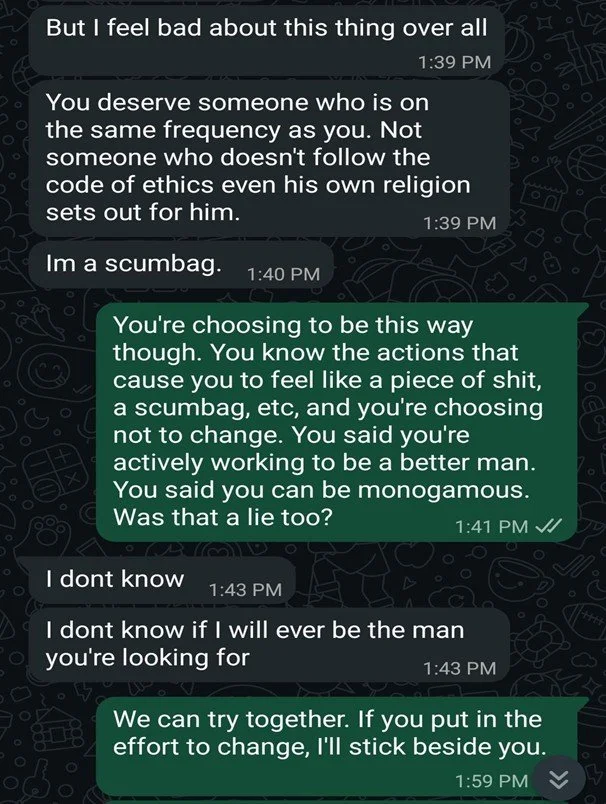
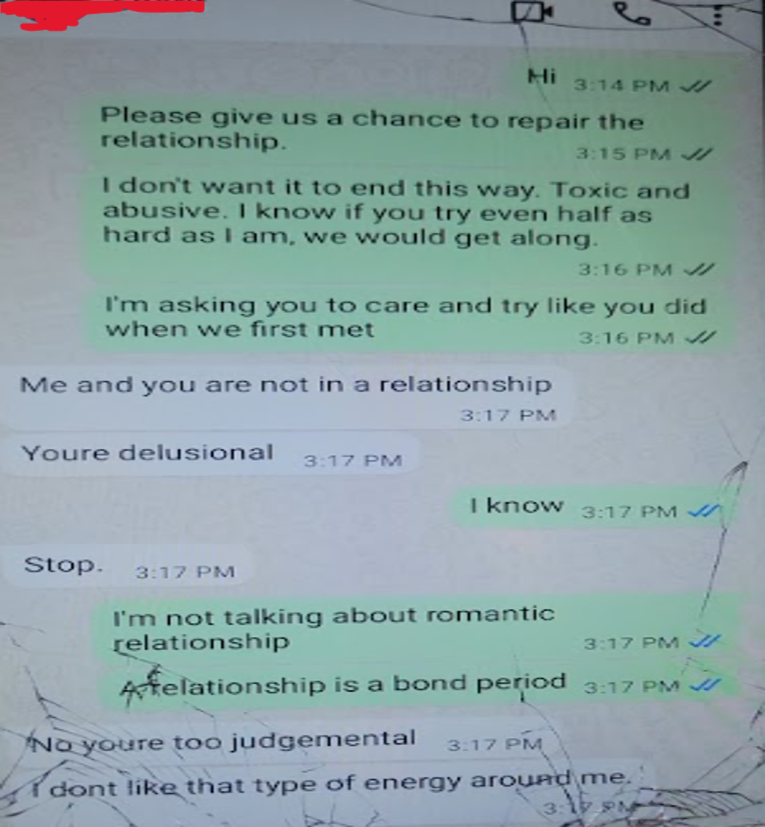
Figure 48 Cycles of remorse, self-deprecation, and false accountability, followed by dismissal and invalidation when repair is requested.
Different Reactions to the Same Pattern
In many cases, he does not have to change. Some women see the red flags, cut their losses, and move on. Others are content dating him on his terms.
I am the delusional, emotionally unstable, obsessive, disrespectful, weirdo, prude, psycho ex who did not, and could not.
These are all convenient and commonly accepted defenses.
I did become many of those things, but the key distinction is when it happened. It happened after months of being on the receiving end of emotional abuse. My emotional state, declining mental health, and the extreme lengths I took to uncover the truth were not the cause of the abuse, they were symptoms of it.
He has a pattern. Everyone reacts to that pattern differently.
Other women have anonymously shared their experiences with him through private online forums, and their accounts mirrored mine, often with fewer details. I have never behaved the way I did with him in any of my previous relationships, and I am currently in a very healthy relationship.
Taking Responsibility Without Accepting Blame
I am not excusing my behavior.
Near the end of our relationship, I began emotionally lashing out at him. I may have said things that were hurtful to him. I called him repeatedly, left voice memos and voicemails, and attempted to contact his family.
My intention in sharing this is not to justify my actions, but to affirm others who may have reacted similarly. Research shows that these responses can and do occur in abusive relationships.
The Psychological Toll of Prolonged Devaluation
I will try to describe the pain of being sexually diminished, devalued, ignored, blamed, and lied to for months, even when you present proof and logical explanations.
Figure 49 Sexual coercion and verbal degradation used to silence concerns and reframe compliance as the condition for harmony.
You feel absolutely worthless. Even if the person never explicitly says it, their actions and subtle remarks penetrate your soul. Over time, you begin to believe that if you just did a little more sucky sucky and a little less talky talky, things would improve.
Everything becomes your fault.
It’s my fault for planning.
It’s my fault for having standards and expectations.
Maybe they’re too high.
After all, I was single and abstinent for two years.
So I tried it his way. I removed my rules, my standards, and my boundaries. I told myself that if I complied, if I did what he wanted, he would finally reciprocate and commit.
But even then, it didn’t happen.
Endless Excuses, Shifting Goalposts
Why?
Because of Islam.
Because of Teaching Fellows.
Because he was sick.
Because I was “too much.”
Because I wasn’t his wife.
But I was lonely.
Yes, I had friends, but platonic companionship is not a substitute for romantic companionship.
What was I supposed to do?
I needed him. I wanted him. I was desperate for him to love me. I would have done anything to fill the emptiness and return to the incredible first four months of the relationship.
I could date other people, but they weren’t him. I still wanted him.
Why It Felt Like Love (But Wasn’t)
Why?
Because when we were together, it felt euphoric. My heart raced. I felt tingles in my fingertips, butterflies in my stomach, and lightheadedness. My body yearned for his touch after being deprived of affection for so long. Hearing his voice temporarily soothed the pain.
I had never felt this way about anyone before. No one had ever made me feel the way he did.
So I thought it must be love.
But it wasn’t love.
It was addiction.
The animated short film Nuggets by Film Bilder & Friends provides a powerful visual metaphor for this addictive cycle: https://youtu.be/HUngLgGRJpo?si=PV4shI1VuswQ4Xwo
The Slot Machine Effect
Psychiatrist Dr. Tracey Marks explains the slot machine effect in toxic relationships:
“Dopamine isn’t the feeling of winning at the slot machine. It’s what makes you pull the lever over and over again, hoping to win. It thrives on unpredictability, and that’s exactly what your brain is doing in a toxic relationship. It’s gambling. Every time you check your phone, wonder if they’ll show up, or which version of them you’re going to see today, your brain is pulling that lever.”
Sex and the City’s Carrie Bradshaw said it best: “…addicted to the pain, the exquisite pain, of wanting someone so unattainable.”
The unknown is addictive. Unavailable or inconsistent partners are the personification of Russian roulette, peak uncertainty (Tracey Marks).
The longer we knew each other, the less physical time we shared. I heard his voice less. His text responses became briefer. I never knew when I would see him again, but I couldn’t bring it up to him because he would call me dramatic.
Living Inside the Uncertainty
What will happen when I reach out to him this time? What response will I get this time?
Will he call me habibti, cupcake, and princess? Or will I be called a psycho, dramatic, or prude?
What can I do to get those terms of endearment back?
If I just stopped having needs and only did what he said and liked, everything would go back to the way it was.
I’m scared of losing him. I have a sinking feeling that I’m being used. Our relationship feels one-sided. I’m confused about why he won’t compromise the way I have for him. I have made so many concessions, and he still wants more. If I bring it up, I’m accused of keeping a long list of grievances.
I cry myself to sleep alone. I dream of him, pleasant dreams and nightmarish ones. I am sleep-deprived, but I still have to work 60 hours a week. I feel knots in my stomach. I can’t stop crying. I need a release. It physically hurts to be apart from him.
I’ve become addicted to the pain and the relief that follows contact.
Wanting Him In and Out at the Same Time
I want him in my life for the good, but the bad is so painful that I want him out. I block him and instantly regret it. I want him to deliver on his promises, but I logically know he never will.
He’s playing me, but I want to be wrong.
I want to give him more time to prove me wrong. I want to believe him. I want to see proof of his sickness, his teaching certification, and his other excuses so I know he’s telling me the truth.
I need the truth to justify staying.
I need the truth to justify leaving.
What is he hiding?
Why is he lying and saying he’s not?
I know he is. My gut tells me he is, but I have no proof. I have to get proof.
The Search for Answers
I wanted support and found myself questioning whether this was how he treated others in his life. I felt a strong urge to seek clarity, including the idea of reaching out to people close to him, but based on our prior conversations, I understood that this was something he did not want me to do.
I also considered sending a birthday gift to his home as a way of expressing care, but I was left with the understanding that this, too, was not something he was comfortable with.
Why is his ex-wife still texting and calling him? Does she know he’s dating other people? Is she okay with it? He said he doesn’t have kids, so why stay in touch with a man who cheated on you when you weren’t legally married?
I want to ask, but I’m scared.
What would he do if I did? What would I say? How should I reach out?
This is how my brain was thinking during that time.
Withdrawal and No Contact
I didn’t know how to get out of this phase, and I knew logically I couldn’t go back to him.
There is a withdrawal that comes with trying to leave an abusive relationship:
“If you leave or go no contact, your brain will push back. A dopamine drop equals cravings, obsessive thoughts and romanticizing the relationship. This is neurological withdrawal. It’s not proof that you made a mistake. It’s proof that the pattern was deeply wired. Knowing this in advance can help you weather it when you’re lying in bed at three in the morning, convinced you should text them. You can tell yourself: this is withdrawal, and this will pass.” (Tracey Marks)
The withdrawal phase is extremely difficult. Going no contact neurologically hurts.
You may have noticed that he and I communicated through different phone numbers. I asked him to block me numerous times because I kept going back to him, and he refused.
So I acted crazy. And sometimes I genuinely was, because I wanted him to block me.
The most effective way to make that happen was threatening to contact his family, which I wanted to do anyway. He would block me every time. Eventually, he started blocking me for other reasons: I was judgmental, high-nosed, or not answering his questions the way he wanted.
I blocked him too, but my reason was different. I didn’t want to answer him immediately, and I didn’t want to see his apathetic replies right away.
Whenever he blocked me, I would experience separation anxiety and sometimes panic attacks. I used one of my old phones to call and text him excessively, desperate to get back in contact. He would continue talking to me on a new number until we fought again, he blocked me, and the cycle repeated.
When the Cycle Finally Stopped
The cycle finally ended when I brought up his criminal history. I knew that was his biggest insecurity. After that, my attempts to contact him appeared to go unanswered, and I was unable to reach him through the usual means. Based on my understanding of the situation, I felt that further communication was not welcome, as calls were not received and messages did not elicit a response.
It wasn’t what my body wanted, but it was what my mind needed. I thanked him for blocking me and told him not to unblock me under any circumstances. That boundary gave me the space to finally process the abuse and begin recovery.
Even now, I still experience withdrawal symptoms. Healing from trauma takes time. I am maintaining no contact. Learning that he lied to me about having a child has helped me keep that boundary. That was when I finally felt I had enough truth to let go of the search, and the illusion of our relationship.
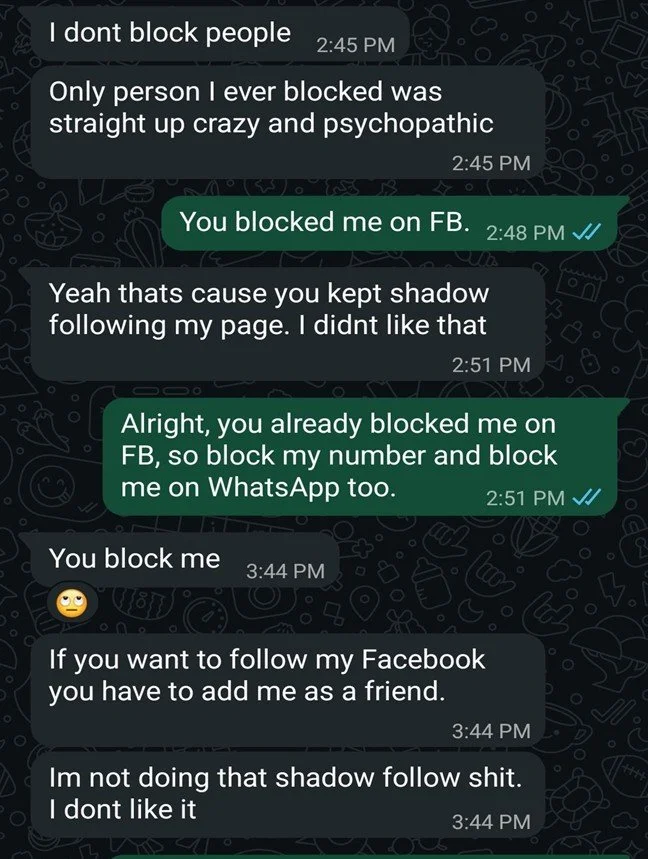
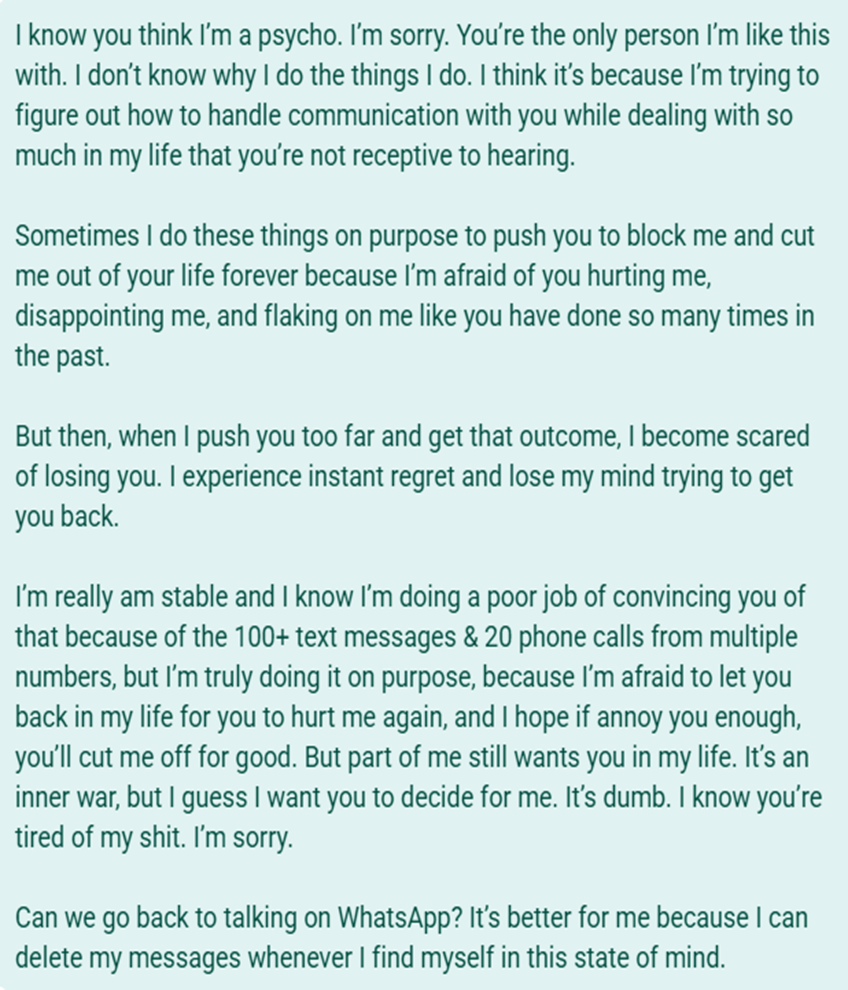
Figure 50 Trauma-bonded pursuit and coerced blocking, where fear of abandonment, intermittent reinforcement, and refusal to disengage sustain the abusive cycle.