
Chapter 5: Using Emotional Abuse
Emotional abuse was a constant feature of my relationship with him. Rather than isolated incidents, his behavior formed a persistent pattern of degradation, humiliation, invalidation, and psychological destabilization. These tactics eroded my self-esteem, distorted my sense of reality, and reinforced a power imbalance in which my emotional needs were minimized or punished.
Degradation and Humiliation
When I shared personal or professional accomplishments with him, he frequently responded by reducing them to sexual remarks. Rather than acknowledging my work, effort, or success, he reframed my achievements through a sexualized lens, stripping them of meaning and turning moments of pride into moments of objectification.
This pattern discouraged me from sharing positive experiences and conditioned me to expect ridicule or dismissal instead of support.



Figure 23 Examples of sexualized responses to personal and professional accomplishments. Rather than acknowledging my achievements, he repeatedly reframed moments of pride into sexual commentary, reinforcing a pattern of objectification and humiliation.
Name-Calling and Verbal Attacks
He repeatedly called me degrading names, including freak, psycho, crazy, weirdo, prude, and dramatic. These labels were often used during disagreements or moments when I expressed discomfort, asserted boundaries, or asked for accountability.
Making Me Question My Sanity
He regularly framed my emotional responses as evidence that something was wrong with me. One recurring example involved my desire to be integrated into his life. After months of dating, I expressed that it felt reasonable to meet or communicate with his family or friends. He responded by portraying this desire as inappropriate, excessive, or threatening.
When I attempted to follow through on this boundary, by asking questions or expressing intent, he would block me or threaten to do so, reinforcing the idea that my expectations were unreasonable and dangerous.
This behavior reinforced self-doubt and caused me to second-guess normal relational needs.
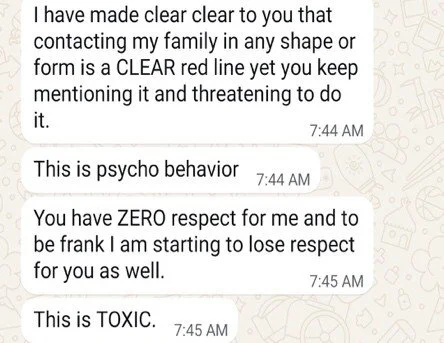
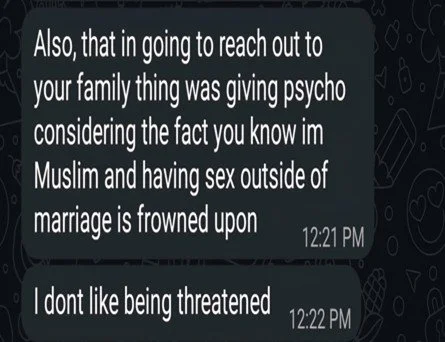
Figure 24 Text messages illustrating the pathologizing of normal relational expectations and the use of blocking and accusations to discourage boundary-setting.
Playing Mind Games and Withholding Stability
The relationship itself was structured as a psychological push-and-pull. Over time, he repeatedly downgraded the nature of our relationship:
· From girlfriend
· To open relationship
· To friend
· To nothing
These shifts were not mutual decisions but unilateral redefinitions made by him, often after conflict or boundary-setting. Monogamy was presented as conditional and temporary, always dependent on my compliance and willingness to accept changing terms.
The goalposts were constantly moved. Stability was dangled as a possibility but never secured, keeping me emotionally off-balance and invested in trying to regain a version of the relationship that was continually withdrawn.
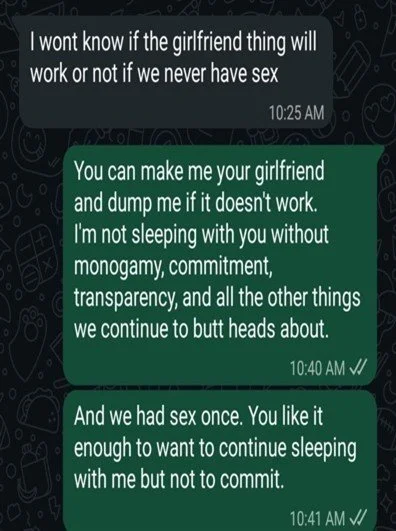

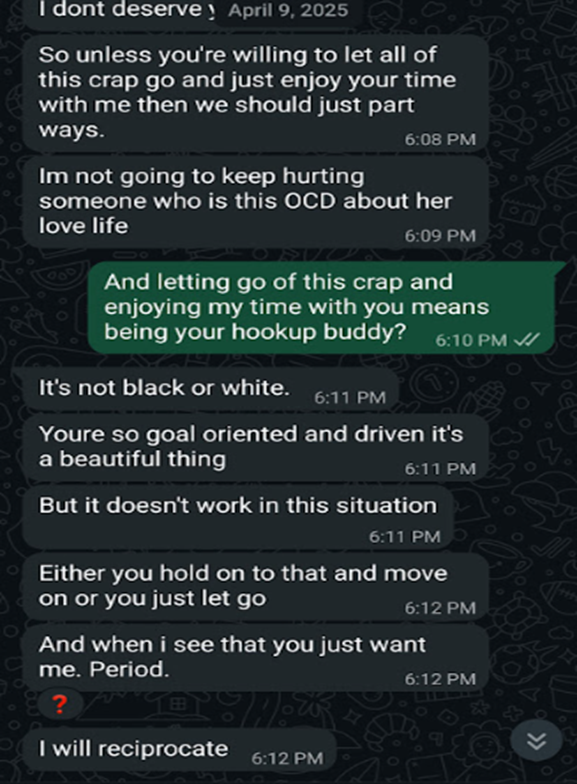
Figure 25 Messages illustrating the repeated downgrading of the relationship and the use of conditional intimacy to maintain control, creating instability through shifting terms, withdrawn commitment, and moving goalposts.